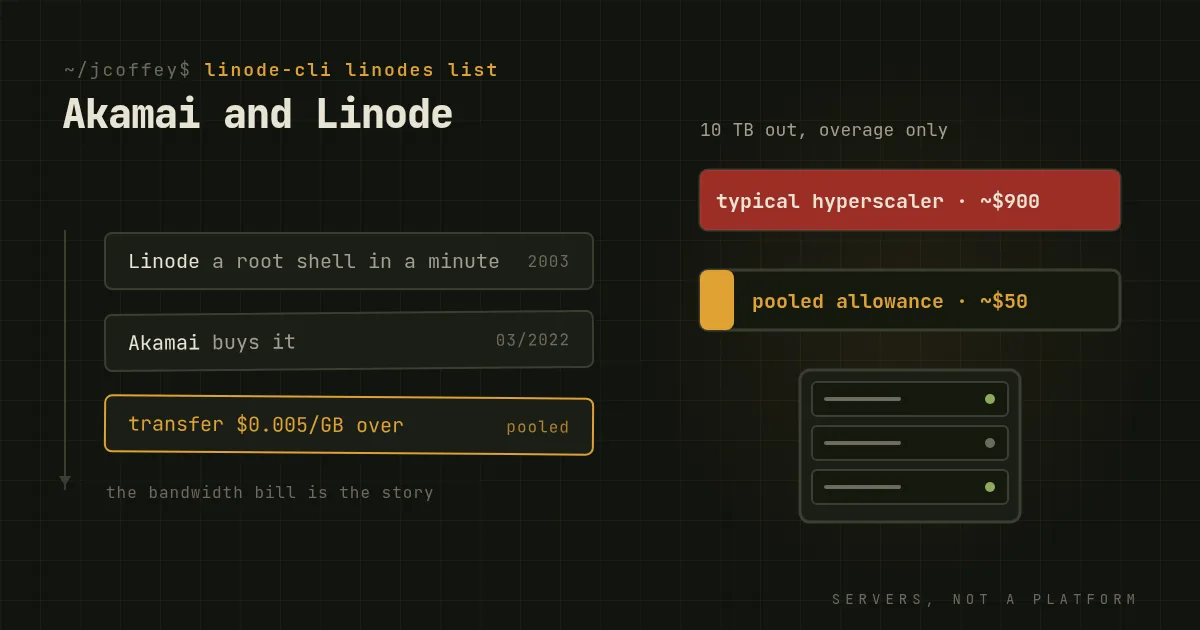
For a lot of people who learned to run Linux servers in the 2000s and 2010s, Linode was where they rented their first one. It was cheap, it was simple, it gave you a root shell on a real Linux machine in under a minute, and its library of guides taught a generation how to set up a web server, a mail server or a firewall.
In 2022 Akamai, the company that more or less invented the content delivery network, bought it for about $900 million. Two years on, it's worth looking at what that combination is, and who it suits.
Linode, briefly
Christopher Aker founded Linode in 2003, which makes it one of the earliest virtual private server providers. It ran on User-mode Linux, then Xen, and since 2015 on KVM. The pitch never changed much: virtual machines with predictable monthly prices, generous bandwidth, a clean control panel and an API, and support from people who knew Linux.
What it sells today:
- Compute: shared-CPU instances from a few dollars a month, dedicated-CPU instances for steady workloads, high-memory plans and GPU instances.
- Kubernetes: the Linode Kubernetes Engine, with the control plane included at no charge.
- Storage: block storage volumes, S3-compatible object storage and backups.
- Networking: NodeBalancers for load balancing, cloud firewalls, private VLANs and free DNS hosting.
- Managed databases for MySQL and PostgreSQL.
Why Akamai bought it
Akamai has one of the largest edge networks in the world, with servers in thousands of locations inside ISPs, built for delivering content and blocking attacks. What it didn't have was general-purpose compute: somewhere customers could run their applications, not just cache and protect them.
Linode gave it that, with an existing customer base and a working platform. Since the purchase Akamai has been expanding Linode's core regions and describing its combined offering as a distributed "connected cloud," with compute running from big regions out to the edge, closer to users than the hyperscalers' data centers. The strategic bet is that applications increasingly want to run near their users, and that Akamai's network gives it a head start there.
Where it's genuinely good
Bandwidth pricing. This is the big one. Every Linode instance includes a monthly transfer allowance, pooled across your account, measured in terabytes. Overage is half a cent per gigabyte. The major clouds charge roughly eight to twelve cents per gigabyte of outbound traffic. For anything that serves files, video or heavy API responses, the difference can be larger than the compute bill.
Predictability. A given instance costs a given amount per month. No data transfer surprises inside the allowance, no hourly fee for the public IPv4 address that comes with each instance, no free-tier trap that expires.
Simplicity. A small, coherent set of services that covers what most applications need, documented clearly. Linode's guides library is still one of the best free Linux resources on the web.
A real Linux machine. Root access, your choice of distribution, rescue mode and a console that works when you've broken the network configuration.
Where to be careful
- It's not AWS. If your design depends on dozens of managed services, a serverless platform, a data warehouse and an identity system with a thousand permissions, the big three have far more of them.
- Fewer regions than the hyperscalers, though Akamai is adding them.
- Enterprise gravity. Akamai's core customers are large enterprises, and products follow the money. Some longtime Linode users worry the scrappy, developer-first character will fade as the company optimizes for big contracts. That hasn't happened yet in any dramatic way, but it's worth watching.
- Managed means more money. Hands-off managed services exist, but you pay extra for them. Linode is at its best when you can run Linux yourself.
Who it's for
- Developers and small teams who want servers, not a cloud platform to learn.
- Self-hosters running mail, chat, Git, wikis and other services on a handful of VMs.
- Anything bandwidth-heavy, where the transfer pricing changes the economics.
- Kubernetes users who want a managed cluster without paying for the control plane.
- Businesses that want an exit plan. Building on plain Linux VMs, Kubernetes and S3-compatible storage keeps you portable between any of the providers in this class.
If that's you, Akamai's Linode remains one of the best-value places to run Linux in the cloud. If you need the full catalog of a hyperscaler, it isn't trying to be that. For the broader comparison, see choosing the right cloud service provider.