Read the marketing pages of the major cloud providers and you'd think they were the same company. Global network, enterprise security, AI-ready, pay as you go. They're not the same, but the real differences are rarely on the brochure. They're in who each one is built for, how they charge you, and how hard it is to leave.
The big three, as they actually are
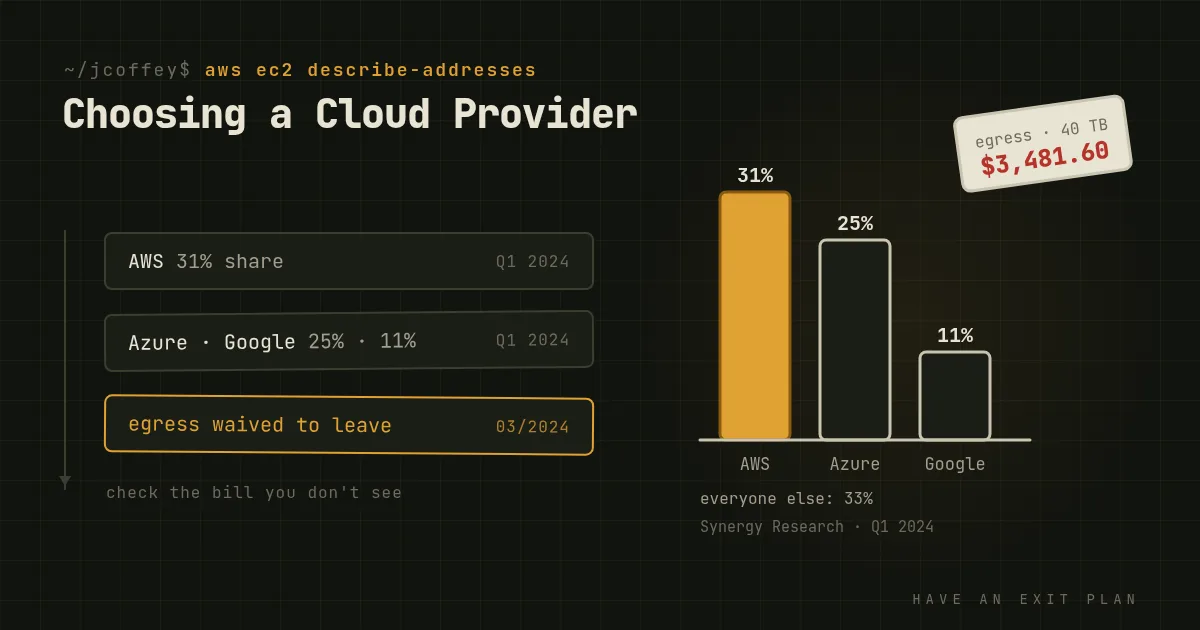
By Synergy Research's count for the first quarter of 2024, AWS holds about 31 percent of the cloud infrastructure market, Microsoft Azure about 25 percent and Google Cloud about 11 percent. Together they take two-thirds of the roughly $76 billion spent that quarter.
AWS is the default. It invented the modern public cloud in 2006 and still has the widest range of services, more than two hundred of them, in the most regions. Almost any third-party tool supports AWS first, and most cloud engineers learned there. The cost of that breadth is complexity: overlapping services, a console that sprawls, and an identity and permissions system powerful enough to lock you out of your own account.
Azure wins on the Microsoft relationship. If your company runs on Active Directory, Microsoft 365, Windows Server and SQL Server, Azure plugs into all of it, and your existing enterprise agreement can make it cheaper than it looks. It's strongest in hybrid setups that tie on-premises Windows estates to the cloud. Its reputation for consistency is weaker, and its security record has had some bad years.
Google Cloud has the strongest engineering lineage for data and containers. It invented Kubernetes, and GKE is still the most polished managed Kubernetes. BigQuery is a superb analytics database, and Google's global network is excellent. It's smaller and has a history of retiring products, so check that a service you depend on is core to Google's business, not an experiment.
The alternative: Linode, now Akamai
Linode has been around since 2003, selling simple virtual servers to developers at flat, predictable prices. Akamai bought it in 2022 and has been folding it into its own cloud brand, pairing those servers with Akamai's enormous content delivery network.
What makes this kind of provider different, and that includes Linode, DigitalOcean, Vultr and OVHcloud:
- Pricing you can read. A 2 GB server is a flat monthly price, with a generous bandwidth allowance included. No calculator required.
- Bandwidth that doesn't bankrupt you. The big three charge roughly $0.08 to $0.12 per gigabyte of outbound data. The smaller providers include terabytes of transfer per server and charge a fraction of that above the allowance.
- Fewer services. Compute, storage, managed databases, Kubernetes, load balancers and object storage, which covers what most applications actually use, and not much else.
For a web application, a SaaS product in its early years, a set of self-hosted services or a dev environment, they're often a third of the price of the big three for the same machines.
The costs that aren't on the pricing page
- Egress. Data coming in is free everywhere. Data going out to the internet is where the big three make their margin, and it's the line item that surprises people most. Video, backups to another provider, an API with heavy responses: model them before you choose.
- IPv4 addresses. Since February AWS charges half a cent an hour for every public IPv4 address, about $44 a year each. More on that in the case for IPv6.
- Managed service premiums. A managed database can cost several times what the same capacity costs as a plain VM. You're paying for backups, failover and patching. Sometimes that's worth it.
- Cross-zone and cross-region traffic, which is billed even inside the provider's own network.
- Support. The business-grade support plans are a percentage of your monthly bill.
The exit fee that just changed
Here's a change this year that matters more than it sounds. Early in 2024, under pressure from the European Union's Data Act, all three hyperscalers announced they would waive egress fees for customers moving their data out to another provider or back on-premises. Google went first in January, followed by AWS and Azure in March. The terms vary: some want you to close your account, all want it done within about sixty days, and all of them require you to ask.
It doesn't make leaving easy. Everything built on proprietary services still has to be rebuilt. But it removes one of the oldest lock-in mechanisms in the business: charging you to take your own data home.
How I'd decide
Skip the feature tables. Answer these:
- What does your team already know? Expertise is the biggest real cost. A team fluent in AWS will run AWS better and cheaper than a "cheaper" cloud it doesn't know.
- What does the rest of your stack already depend on? Deep in Microsoft, look hard at Azure. Living in BigQuery and Kubernetes, look at Google.
- How much data goes out? If it's a lot, the smaller providers or a CDN in front can save more than any discount negotiation.
- How portable do you want to be? Build on Linux VMs, PostgreSQL, Kubernetes, S3-compatible storage and infrastructure as code with OpenTofu, and you can move later. Build on DynamoDB, Lambda and Cosmos DB, and you've chosen your provider for the next decade. That can be the right call, but make it on purpose.
- Where does the data legally need to live? Data residency rules can narrow the field before anything else.
There's no best cloud. There's the one that fits your team, your workload and your exit plan, and the fact that you should have an exit plan is the most important part.
Since then
Added October 2026. Data sovereignty has climbed the list of reasons people choose a provider, especially in Europe, and so has the cost of the services they can't easily leave. I wrote about that wider question in Software You Rent vs. Software You Own, and about the Akamai deal itself in Akamai and Linode.