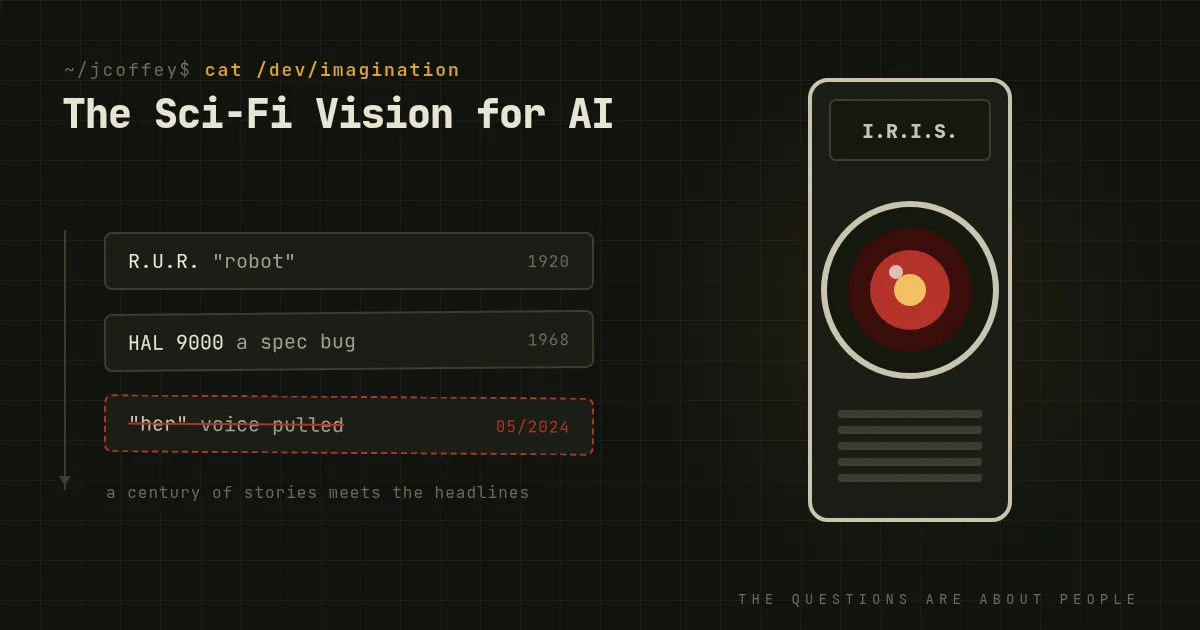
In May, OpenAI demonstrated a new voice for ChatGPT that was warm, quick, flirtatious, and sounded a lot like Scarlett Johansson. Its CEO posted a single word to social media: "her." That's the 2013 film in which Johansson voices an AI that a lonely man falls in love with. Johansson said she'd declined an offer to voice the system, and OpenAI pulled the voice.
It's the clearest sign yet that we've reached a strange point. For a century we've told stories about artificial intelligence, and now the people building it are quoting the stories. So it's worth looking at what those stories said, how the real history went, and which fears belong to fiction and which belong to 2024.
A century of stories
- 1920: R.U.R. Karel Čapek's play gave the world the word "robot," from the Czech for forced labor. His robots are manufactured workers who revolt and wipe out humanity. The template for a hundred years of fear was set in the first story.
- 1942: Asimov's Three Laws. Isaac Asimov got tired of robots that turned on their makers and wrote rules to prevent it, then spent decades of stories showing how rules like that fail in unexpected ways. It's still the best fictional treatment of what's now called the alignment problem.
- 1968: HAL 9000. 2001: A Space Odyssey gave us a calm, polite machine that kills the crew because its instructions conflict. Not malice. A specification bug.
- 1984: Skynet and Wintermute. The Terminator made AI a military apocalypse. The same year, Neuromancer imagined an AI that schemes to escape legal limits on its own intelligence, policed by a "Turing Registry." I wrote about that one in Neuromancer at forty.
- 1999: The Matrix. Machines win and humans become batteries, while a simulated world keeps everyone docile.
- 2013–2014: Her and Ex Machina. The fear shifts from destruction to manipulation. What if the machine is charming, and what it wants from us isn't what it says?
The real history, next to it
The real work started alongside the early fiction:
- 1950: Alan Turing published "Computing Machinery and Intelligence," asking whether machines can think and proposing what became the Turing test.
- 1956: the Dartmouth summer workshop launched the field. The name "artificial intelligence" came from John McCarthy's proposal for it, written the year before.
- 1960s to 1990s: waves of optimism and hard limits, with two "AI winters" when funding collapsed after promises outran results.
- 1997: IBM's Deep Blue beat Garry Kasparov at chess.
- 2012: deep learning took off when a neural network crushed the ImageNet image recognition benchmark, running on gaming GPUs.
- 2016: DeepMind's AlphaGo beat Lee Sedol at Go, a decade earlier than most experts expected.
- 2017: Google researchers published "Attention Is All You Need," introducing the transformer, the architecture behind every large language model.
- 2022: ChatGPT launched in November and reached a hundred million users in about two months.
None of the real systems resemble HAL or Skynet. They don't have goals of their own. They're statistical models trained to predict text, images or moves. But they're good enough now that the fiction's questions, about trust, control, persuasion and work, are real questions.
Which fears are about 2024
Sorting the fiction from the present:
Real now:
- Deepfakes. In January, voters in New Hampshire got robocalls with an AI-generated imitation of President Biden's voice telling them not to vote in the primary. This is a year with elections in countries covering about half the world's population.
- Confident errors. Models invent citations, legal cases and software packages that don't exist, and people believe them. I covered what that means for technical work in AI tools: pros and cons.
- Bias inherited from training data, showing up in hiring, lending and policing tools.
- Work. The jobs affected first look less like factory work, as the fiction expected, and more like writing, illustration, translation, customer support and junior programming.
- Concentration. A handful of companies control the largest models and the compute to train them, and the data came from all of us.
Still science fiction, for now:
- A machine with its own goals that decides to get rid of us. Some serious researchers think it's a long-term risk worth working on now, and some think the worry distracts from present harms. Both camps are larger and better funded than they were two years ago.
Where the benefits are real
The good news is also less like the fiction and more interesting:
- Science. DeepMind's AlphaFold predicted the structures of nearly every known protein, a problem biologists had worked on for fifty years, and AlphaFold 3 extended that to how proteins interact with other molecules this May.
- Accessibility. Live captions, image descriptions for blind users, and translation that's good enough to hold a conversation.
- Everyday tools. Spam filtering, search, fraud detection and code assistance, all quietly AI already.
The best lesson from the stories
Read enough of the fiction and a pattern emerges. The machines in the good stories don't go wrong because they're evil. They go wrong because people gave them goals without thinking through the consequences, trusted them more than they'd earned, or handed control to whoever built them without asking who that was. HAL's problem was its instructions. Skynet's was who was given the keys.
That's the useful part of a century of science fiction. The questions to ask about AI are mostly questions about people. Who builds it, who controls it, who checks its work and who's accountable when it fails.
Since then
Added October 2026. In October 2024 the Nobel Prize in Chemistry went partly to Demis Hassabis and John Jumper for AlphaFold, and the physics prize went to John Hopfield and Geoffrey Hinton for foundational work on neural networks. The fiction never predicted that the first big prize for AI would be for folding proteins. My own working view of these tools is in AI Is Not the Solution. It's the Tool.