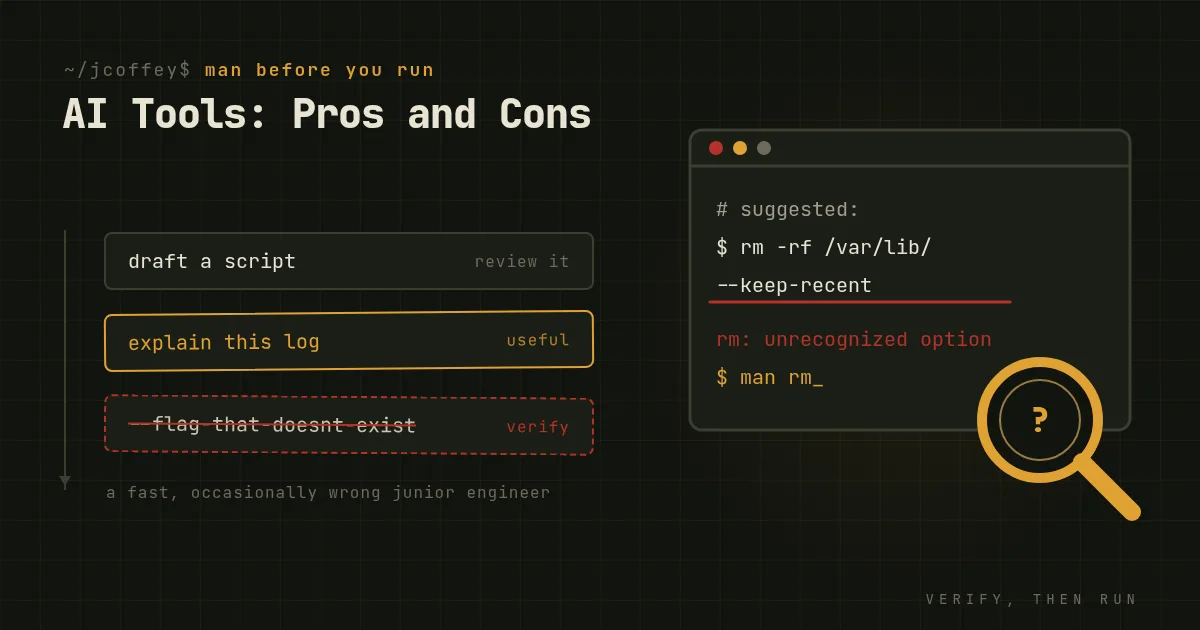
Eighteen months after ChatGPT launched, the argument about AI tools has settled into two camps that are both wrong. One says these things will replace engineers by Christmas. The other says they're autocomplete with a marketing budget and refuses to touch them.
In the last seven weeks OpenAI shipped GPT-4o and Anthropic shipped Claude 3.5 Sonnet, and Meta's Llama 3, out since April, is running on people's own hardware. The tools got good enough to be useful a while ago. They also got good enough to be convincingly wrong. Both of those are true at once, and the useful question is how to get the first without getting burned by the second.
Where they actually save time
For technical work, the wins are real and fairly specific.
- First drafts of things you could write yourself. A Bash script to rotate some logs, an Ansible task, a systemd unit, a regex, a SQL query against a schema you paste in. You'd get there in twenty minutes. The assistant gets you 80 percent of the way in twenty seconds, and you spend five minutes fixing the rest. Treat it like a fast, occasionally wrong junior engineer: useful, as long as somebody reviews the work.
- Reading things you don't know yet. Paste in a stack trace, a cryptic kernel message or a file in a language you don't write, and ask what it's doing. Explaining existing text is where these models are most reliable, because the answer is mostly in front of them.
- Translation between formats. Turn this JSON into YAML, this curl command into Python, this iptables ruleset into nftables. Tedious, mechanical work that's easy to check.
- Documentation nobody wants to write. A first draft of a runbook from your notes, a README from the code, a summary of a long incident channel. A human still has to make it true.
- Rubber-ducking. Explaining a problem to something that asks follow-up questions is often how you find the answer yourself.
Where they've already embarrassed people
The failure mode is always the same: somebody trusted the output because it sounded sure.
- Invented legal citations. In June 2023 a federal judge sanctioned two New York lawyers who filed a brief citing six court cases that ChatGPT had made up, complete with fake quotes. They'd asked it whether the cases were real. It said yes.
- A chatbot's promise is your promise. In February a Canadian tribunal ordered Air Canada to honor a bereavement refund policy its website chatbot invented. The airline argued the chatbot was responsible for its own words. The tribunal disagreed.
- Glue on pizza. Last month Google's new AI Overviews told searchers to add glue to pizza sauce to keep the cheese on, sourced from an old Reddit joke.
- Packages that don't exist. Models regularly recommend software packages that were never published. In March, a security researcher registered one of those hallucinated names,
huggingface-cli, as an empty package on PyPI. It was downloaded tens of thousands of times, and at least one large company's instructions told people to install it. Swap the empty package for malware and you have a supply-chain attack that writes itself.
For a sysadmin, the dangerous version is quieter. A command-line flag that doesn't exist will just fail. One that does exist but does something different from what the model says can take out a system. An rm with the wrong scope or a firewall rule that locks you out over SSH runs exactly as typed, whoever wrote it.
The cost nobody puts in the slide deck
Your data goes somewhere. Anything you paste into a hosted assistant is sent to someone else's servers and handled under their terms. Last year Samsung banned these tools internally after engineers pasted proprietary source code and meeting notes into ChatGPT. Configuration files, logs and stack traces are full of hostnames, internal IPs, usernames and sometimes secrets. Read the data policy of whatever tool you use, and choose the business tier that doesn't train on your input, or run a model locally.
Running one locally is now realistic. Tools like Ollama and llama.cpp run open-weight models like Llama 3 and Mistral on a workstation with a decent GPU, or slowly on a CPU. They're not as capable as the biggest hosted models, but for explaining logs and drafting scripts they're often good enough, and nothing leaves the machine.
Skills atrophy. If the assistant writes every regex, you stop being able to read them, and then you can't review what it wrote. Juniors are most at risk, because they don't yet know what a wrong answer looks like.
Licensing is unsettled. Code suggestions can reproduce training data, and the lawsuits over what that means are still in court. For a personal script it doesn't matter. For code you ship, know your employer's policy.
Ground rules I'd set
- You own what you run. If an AI wrote the command and you executed it, you wrote it. "The AI said so" isn't a postmortem finding.
- Never paste secrets. No keys, passwords, tokens or customer data into a hosted tool, ever. Scrub hostnames and IPs from logs if you can.
- Verify against the source. Check flags in the man page, packages in the official registry, and API calls in the vendor's documentation. The assistant is a pointer to where to look, not the answer.
- Test somewhere disposable first. Anything destructive goes through a VM or staging before it touches production, the same as code from a forum post.
- Prefer local for anything sensitive. If the data shouldn't leave the building, the model shouldn't either.
Used that way, these tools make good engineers faster. Used any other way, they make confident mistakes faster, and those are the expensive kind.
Since then
Added October 2026. The models got much better and the rules didn't change. I wrote the longer argument in AI Is Not the Solution. It's the Tool. The same thinking shapes what Coffey Labs builds: in inbuxa, AI is off in a new install, built to use a model you host yourself, and only reaches a third-party service if the operator turns that on.