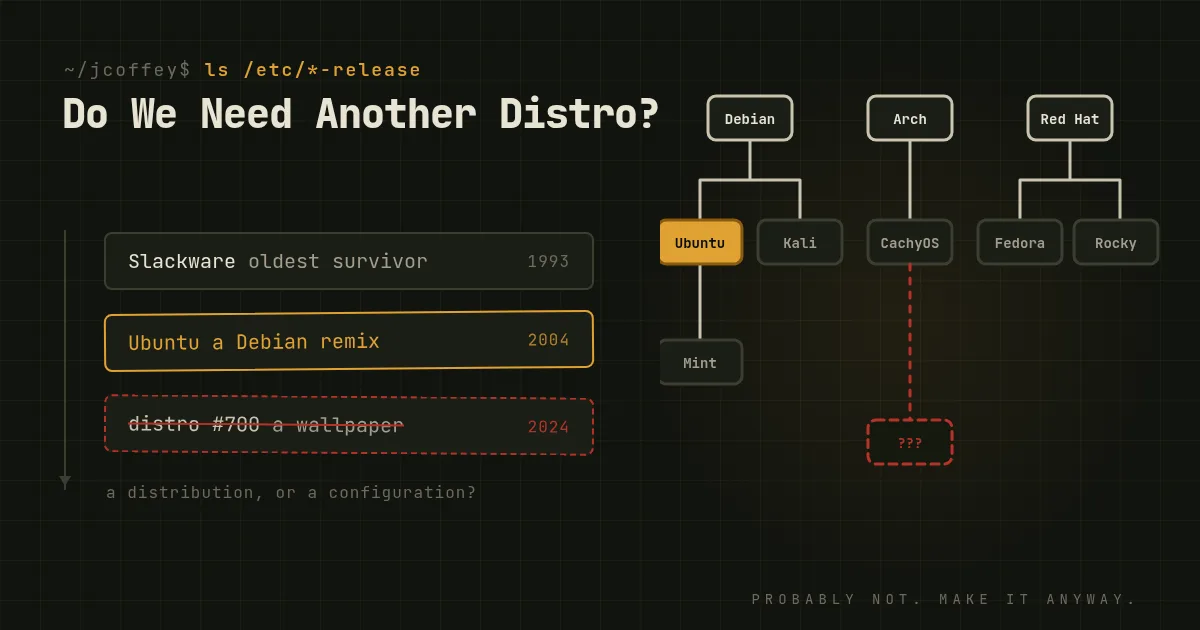
Every week, somewhere, someone announces a new Linux distribution. It's the ultimate Linux experience, it's beautiful, it's fast, it's for gamers or creators or people who like the color purple. DistroWatch tracks several hundred active ones and has a waiting list of more.
Do we need another one? Probably not. Will someone make one anyway? Definitely. And I think that's mostly a good thing. But it isn't free, and the people starting one should know what it costs.
Why there are so many
Because you can. That's the whole answer, and it's a good one. The kernel, the GNU tools, the desktops and the package managers are all open source. Anyone can assemble them differently, give the result a name and a wallpaper, and publish it. No permission is required, and none should be.
In practice, the hundreds collapse into a handful of families:
- Debian and its descendants, including Ubuntu, Linux Mint, Pop!_OS, Raspberry Pi OS, Kali and many more.
- Red Hat and friends: Fedora, RHEL, CentOS Stream, Rocky and AlmaLinux.
- Arch and its descendants, like Manjaro, EndeavourOS and CachyOS.
- SUSE, with openSUSE Leap and Tumbleweed.
- Independents with genuinely different ideas: Gentoo, Slackware, the oldest survivor, from 1993, Alpine, Void and NixOS.
Most new distributions are a member of one of those families with a different default desktop, theme and set of preinstalled apps. That's not a criticism. It's what remixing looks like.
What all that choice costs
- App developers can't target "Linux." Different library versions, package formats and directory conventions mean shipping software for Linux has historically meant shipping it for several Linuxes. Flatpak, Snap and AppImage exist largely to paper over that, and they've helped.
- Security support thins out. A big distribution has a security team watching for vulnerabilities and shipping fixes within days. A one-person distribution depends on that person not being on vacation when the next OpenSSH flaw lands, like the regreSSHion bug disclosed this month.
- Abandonment. Many small distributions stop updating after a year or two, and their users find out when something breaks.
- Confusing newcomers. "Which distro should I use?" is the first question every new Linux user asks, and the hundred conflicting answers send some of them straight back to Windows.
- Duplicated work. Every derivative that rebuilds and repackages the same thing is time not spent fixing the upstream it came from.
What it's given us
On the other hand, a surprising amount of what's now standard started as somebody's "unnecessary" distribution:
- Ubuntu was a Debian derivative in 2004, and it made Linux on the desktop approachable for millions of people.
- Arch's wiki became the best Linux documentation in existence, used by people who've never run Arch.
- NixOS proved that a whole system could be described declaratively and rebuilt reproducibly, ideas that are now spreading everywhere.
- Immutable desktop distributions like Fedora Silverblue, and Valve's SteamOS, are changing how desktop Linux is updated.
- Asahi Linux got Linux running on Apple Silicon Macs, against all odds.
Plenty of distributions are experiments. Most experiments fail. The ones that succeed change everyone's defaults, and you can't know in advance which those will be.
What I'd tell someone about to launch one
Ask yourself honestly whether your idea is a distribution or a configuration.
If it's a theme, a set of preinstalled apps and some sensible defaults, it's a configuration. Publish it as a script or an Ansible playbook for an existing distribution, or contribute it upstream as an option. You'll reach more people and maintain far less.
If it's a genuinely different idea about how the system should be built, updated, secured or used, then build it. Just commit to the boring parts: security updates, a release schedule, a plan for when you lose interest. Users will trust you with their machines. That deserves more than a weekend.
And if you're a user choosing one: pick from a big family, with a security team and a track record. Try the new ones in a virtual machine for fun. The joy of Linux is that you can.
So no, we don't need another Linux distribution. But the freedom to make one anyway is the same freedom that gave us all the good ones.
Since then
Added October 2026. I came back to the subject from the other direction in Get Over Yourself and Support the Distro, about what the distributions we do have need from the people who use them.