Put a job description for a Linux systems engineer next to one for a Windows systems administrator at the same company and you'll usually notice something. The Linux one is longer. It asks for scripting, networking, a couple of databases, a configuration management tool, containers, a cloud platform, a monitoring stack and "experience with open source software." The Windows one asks for deep knowledge of a coherent, well-integrated set of Microsoft products.
That isn't because Linux people are smarter. Plenty of Windows administrators know Active Directory, Group Policy and Exchange at a depth most Linux engineers never reach. It's because of how the two worlds are built. Here's why the Linux job tends to be broader, and why that breadth is both a strength and a trap.
Linux runs everywhere, so the job does too
Windows Server lives mostly in one place: the enterprise data center and its cloud equivalent, running identity, file services, line-of-business applications and SQL Server.
Linux runs web servers, databases, container platforms, network appliances, storage systems, supercomputers, routers, cloud control planes and embedded devices. A Linux engineer in a mid-sized company might, in the same week, debug a web server, tune a database, fix a firewall rule, update a Kubernetes cluster and figure out why an appliance's embedded Linux won't take an update. The platform is general-purpose, so the job is too.
Nobody ships the whole stack
Microsoft builds an integrated ecosystem. The directory, the management tools, the patching system, the monitoring and the database are designed to work together and come from one vendor. That's a real strength, and it lets Windows administrators specialize deeply in a known set of products.
A Linux environment is assembled. The kernel comes from one community, the distribution from another, the web server from a third, the database from a fourth, monitoring from a fifth, and configuration management from a sixth. Each has its own configuration format, logging, documentation and failure modes. Somebody has to understand how they fit together, and that somebody is the Linux engineer.
You can look inside, so you're expected to
On Linux, nearly everything is a text file and nearly everything is open source. When something behaves strangely, you can read the configuration, trace the system calls with strace, read the source code and, in principle, fix it. That's one of the best things about the platform.
It also raises the bar. "The vendor will tell us" is rarely an answer on Linux, because often there's no vendor to ask. The engineer is expected to dig. Over years, that habit builds a very wide understanding of how systems work underneath.
Automation is the default, not an option
PowerShell is excellent, and Windows administration has become far more automated over the past decade. But Linux environments were text-and-scripts first by necessity. A Linux engineer is expected to be comfortable in Bash, usually Python, and a configuration management tool like Ansible, and increasingly with infrastructure as code. That's a programming skill set layered on top of an operations one.
The networking and security load
Because Linux sits at the edges, as the web server, the reverse proxy, the VPN gateway or the firewall, Linux engineers end up owning a lot of networking and security: TLS, DNS, packet filtering with nftables, SELinux or AppArmor policy, SSH hardening and reading packet captures. In a Windows-centric organization, much of that sits with dedicated network and security teams.
The trap: breadth isn't depth
Here's the part this argument usually leaves out. A broad role can produce engineers who know a little about everything and not enough about anything. Knowing how to restart PostgreSQL isn't knowing PostgreSQL. Having written a Kubernetes manifest isn't being able to debug a cluster at 3 a.m.
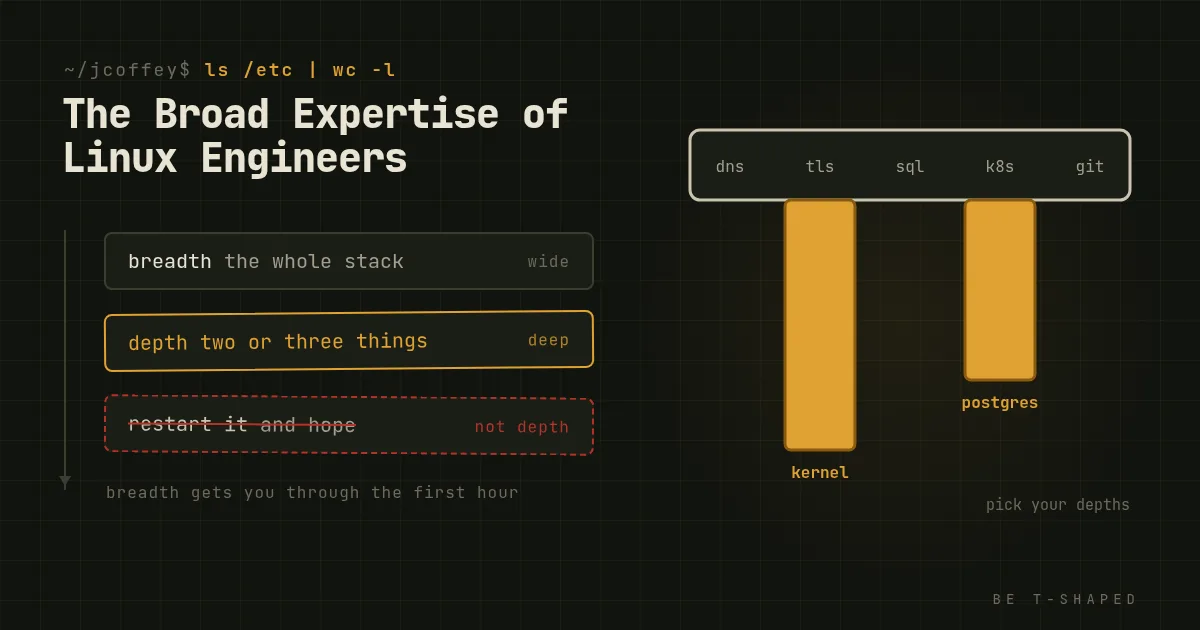
The engineers who thrive in these roles are usually T-shaped: broad enough to understand how all the pieces connect, and deep in two or three of them, often the kernel and networking, a database, or a particular platform. Pick your depths deliberately. Breadth gets you through the first hour of an incident. Depth gets you through the rest of it.
The other half
None of this means Linux engineers can ignore the rest of the world. Most organizations run both, and the most useful engineers are comfortable on either side of the fence. I made that case in why being platform agnostic is crucial for Linux systems engineers, and the day-to-day version of it in a day in the life of a Linux systems engineer.