There's a lot of noise around blockchain in 2024. Bitcoin exchange-traded funds started trading in the US in January. The founder of FTX, once one of the largest crypto exchanges, was sentenced to twenty-five years in prison in March. Somewhere in between, a consultant is pitching a blockchain for something that would work better as a spreadsheet.
Under the noise is a genuinely clever piece of computer science. It's worth understanding properly, both to see what it's good for and to recognize when it's being sold for something it isn't.
The problem it solves
Keeping a shared ledger is easy when someone's in charge. A bank keeps the record of who owns what, and everyone trusts the bank. The hard question, studied by computer scientists for decades as the Byzantine generals problem, is how a group of participants who don't trust each other, some of whom may lie, can agree on a single record with nobody in charge.
In 2008 someone writing as Satoshi Nakamoto published a nine-page paper describing Bitcoin, which solved a version of that problem in the open, with anyone allowed to join. The solution combines a few ideas that already existed into something new.
How it works
Hashes. A cryptographic hash function like SHA-256 turns any input into a fixed-length fingerprint. Change one bit of the input and the fingerprint changes completely, and you can't work backward from the fingerprint to the input.
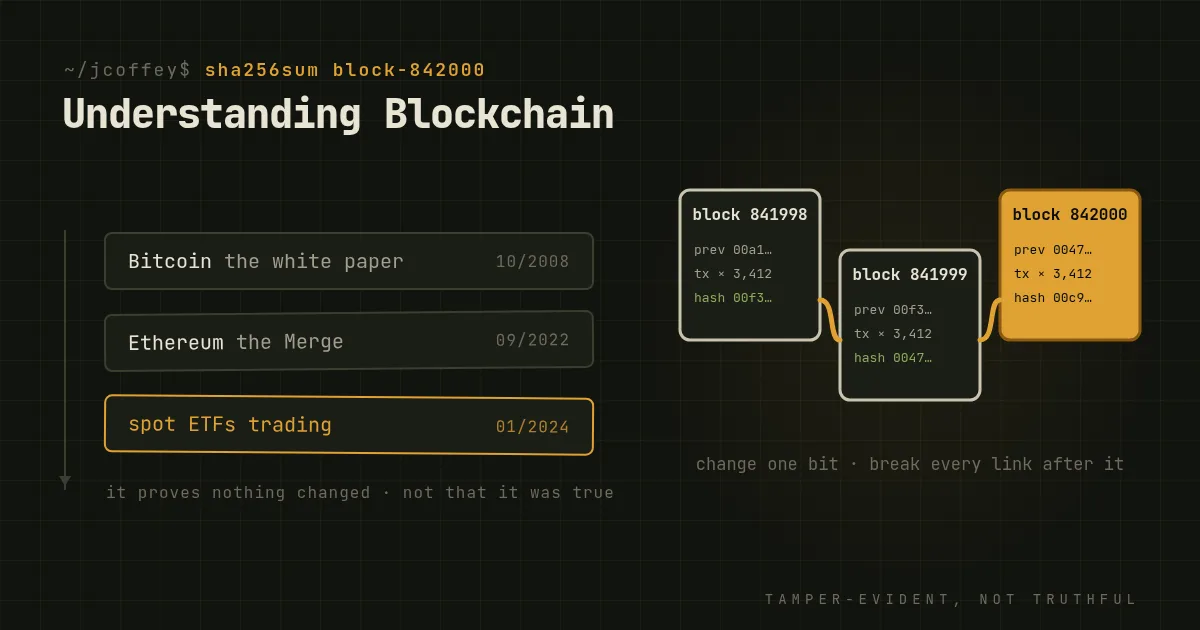
Blocks and chains. Transactions are grouped into blocks. Each block includes the hash of the block before it. So if anyone alters an old transaction, its block's hash changes, which breaks the link from the next block, and the next, all the way to the present. Tampering with history is immediately visible. That's the "chain."
Merkle trees. Inside each block, the transactions are hashed in pairs, then the pairs' hashes are hashed, and so on up to a single root hash. That lets anyone prove a transaction is in a block without downloading the whole block.
Consensus. The hard part: who gets to add the next block? Bitcoin's answer is proof of work. Miners compete to find a number that, hashed together with the block, produces a hash below a target value. The only way to find one is brute force, which takes enormous computing power. The winner adds the block and is paid in new bitcoin. To rewrite history, an attacker would need to redo all that work faster than the honest network, so for a large network it's prohibitively expensive.
Proof of work is secure and staggeringly wasteful. Bitcoin's network uses electricity on the scale of a mid-sized country. So other designs emerged:
- Proof of stake, where validators lock up their own coins as collateral and lose them if they cheat. Ethereum switched to it in September 2022, an event known as the Merge, and cut its energy use by more than 99 percent.
- Byzantine fault tolerant protocols for permissioned networks, where the participants are known organizations voting on each block, fast and efficient but not open to anyone.
Smart contracts. Ethereum, launched in 2015, added programs that live on the chain and run exactly as written, holding and moving assets by their own rules. That's powerful, and also unforgiving: a bug in a smart contract can't be patched quietly, and billions of dollars have been lost to exactly that.
What it's genuinely good at
- Censorship-resistant money. A payment system that no government or company can freeze or block. Whether you think that's good depends heavily on who's using it, but it's real and it's new.
- Stablecoins, tokens pegged to a currency like the dollar, have become a fast way to move value across borders, particularly where banking is poor.
- Tamper-evident records between parties who don't trust one another. The tamper evidence holds up. The hard part is getting the parties to agree to share a system.
- Ideas that escaped. Merkle trees and append-only logs are now everywhere, including in Certificate Transparency, which logs every web certificate publicly, and Git, which has always worked this way. Plenty of the good ideas don't need a blockchain at all.
What it was oversold for
Healthcare records, supply chains, voting, land registries, music royalties, carbon credits: in the late 2010s, blockchain was going to fix all of them. Most of those projects quietly stopped. The reason is usually the same. A blockchain guarantees that the record wasn't changed after it was written. It can't guarantee that what was written was true. A shipment logged on a chain as "organic" is exactly as organic as the person who typed it in. If there's a trusted party who can vouch for the inputs anyway, a normal database run by that party is faster, cheaper, private and fixable when someone makes a mistake.
Voting deserves a special mention, because the proposals keep coming back. Security researchers are close to unanimous that internet and blockchain voting are a bad idea: the problems are voters' compromised devices, secret ballots and verifiable paper trails, and a blockchain solves none of them.
A test you can use
When someone proposes a blockchain, ask four questions:
- Do several parties need to write to a shared record?
- Do they distrust each other?
- Is there genuinely no intermediary they'd all accept?
- Can the data's truth be checked without trusting whoever entered it?
If the answer to any of them is no, you probably want a database. If all four are yes, you might have a real use case, and the technology is fascinating. For where the enterprise side has gone, see LF Decentralized Trust.