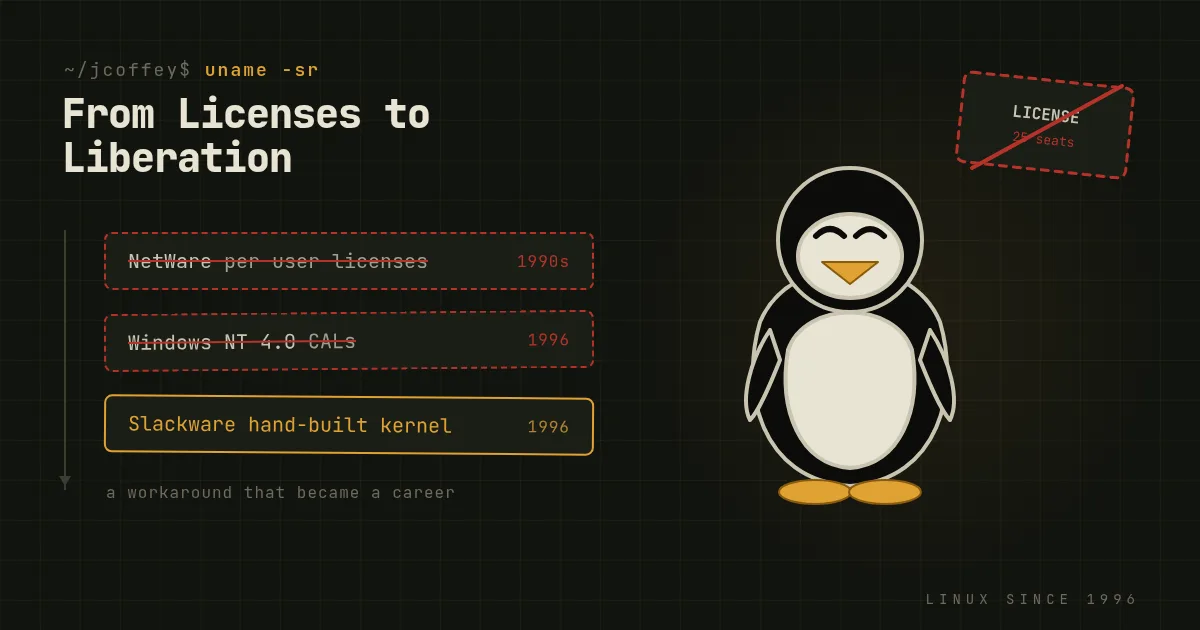
I started in IT when proprietary vendors ran everything. Banyan VINES did the networking, Novell NetWare did file and print, and Windows NT 3.51 and 4.0 were moving in to run domains. Each came with licenses to buy, count and renew, and often hardware it insisted on.
In 1996 I came to Linux, not out of passion, but because it solved a licensing problem. It started as a workaround. It became my career. This is how Linux changed over that time, as I saw it.
1996 to 2001: raw, but already useful
Linux was rough then. I hand-compiled Slackware kernels, edited XF86Config by hand to get a display working, and hoped the ppp dial-up link would stay up. Network cards, sound cards and even mice could take an afternoon of hacks.
But it already had three things nothing else I used had: no license fees, the full source code, and complete control. On servers it started replacing expensive commercial UNIX quickly. My early deployments were mail with Sendmail, file sharing with Samba, and web hosting with Apache.
The problems were real too: weak driver support, a steep learning curve, distributions that each did things differently, and little commercial support to point a manager at.
2002 to 2010: Linux goes to work
This is when business took it seriously. Red Hat Enterprise Linux and SUSE Linux Enterprise Server gave companies something with a support contract. Debian stayed the community's distribution, and Ubuntu, from 2004, made the desktop friendlier.
The tools grew up. iptables replaced ipchains. LVM made disks flexible. Xen and then KVM brought virtualization. Linux, Apache, MySQL and PHP, the LAMP stack, ran a large part of the web.
Linux was now an enterprise platform. The desktop still lagged, a lot of applications only ran on Windows, and hardware vendors still preferred closed drivers.
2010 to 2020: the default for servers
DevOps, the cloud and infrastructure as code all grew up on Linux. Docker arrived in 2013 and made containers easy. Kubernetes followed in 2014. systemd replaced the old init systems in most distributions, controversially. SELinux and AppArmor matured.
Every major cloud ran on Linux, and Microsoft, once openly hostile, started contributing to the kernel and shipped the Windows Subsystem for Linux. Android put a Linux kernel into billions of pockets, and routers, TVs and other devices ran it out of sight.
Hardware support became good. Ansible, Puppet and Terraform made fleets manageable. Red Hat, SUSE and Canonical made support contracts normal.
Today: everywhere
Linux now isn't one operating system so much as a family of them, running almost everything: cheap virtual servers and supercomputers, most cloud workloads, cars, TVs, routers, medical equipment, and the phones in our pockets. Containers are built straight from Linux kernel features, namespaces and cgroups.
Its strengths are security tooling such as SELinux, nftables, auditd and eBPF; scale from a Raspberry Pi to a hyperscaler; source you can read and audit; and an enormous ecosystem.
Its weaknesses haven't all gone. Distributions still differ enough to make packaging hard. The desktop is better than ever and still a small share. Arguments over systemd showed tension over who makes decisions. And vendors are pulling back on openness, as Red Hat did when it restricted RHEL's source.
Where it goes next
My predictions:
- Sovereignty. As governments and institutions worry about who controls their infrastructure and data, Linux gives them a way out. I expect more national and public-sector distributions, and more interest in open hardware.
- The edge. As work moves out to telecom sites, shops and devices, Linux will get smaller and more hands-off. Image-based, immutable systems like Fedora CoreOS and Flatcar will lead that.
- Observability. eBPF gives the kernel a safe way to watch and react to itself. Paired with smarter analysis, it'll be at the heart of infrastructure that notices and fixes its own faults.
- Governance. The biggest threat isn't technical. It's economic. Elastic, HashiCorp's Terraform, Redis and Red Hat's RHEL source have all moved away from openness when money got involved. Open source has to defend itself against that, and Linux's decentralized, GPL-licensed model has to be protected.
Looking back
What started as a way around restrictive licenses became a career, and a way of seeing things. Linux's story is a long argument between control and freedom, monopoly and community. I see it as proof of what people can build when they share the work openly, and I'm proud to have built a career on it.
Since then
Added October 2026. The sovereignty prediction is playing out: several European public bodies have announced moves off Microsoft software toward Linux and LibreOffice, citing control over their own systems. And the work I did as LINUXexpert.org has grown into Coffey Labs, a small company that builds self-hosted, open source software, all of it running on Linux.